Where Can I Find Giant Size Tamarer Hindi Seed in Houston Tx
| Tamarillo | |
|---|---|
 | |
Scientific classification  | |
| Kingdom: | Kingdom Plantae |
| Clade: | Tracheophytes |
| Clade: | Angiosperms |
| Clade: | Eudicots |
| Clade: | Asterids |
| Order: | Solanales |
| Family: | Solanaceae |
| Genus: | Solanum |
| Species: | S. betaceum |
| Binomial name | |
| Solanum betaceum Cav. | |
| Synonyms[1] | |
| |
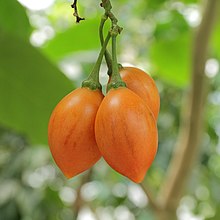
The tamarillo (Solanum betaceum) is a small tree operating theater shrub in the flowering plant kin Solanaceae (the nightshade family). It is best known as the species that bears the tamarillo, an egg-shaped eatable fruit.[2] It is also well-known as the tree tomato,[3] tomate de árbol, tomate andino, tomate serrano, blood yield, tomate Delaware yuca, tomate de españa, sachatomate, berenjena,chilto and tamamoro in South America, and terong Belanda (Dutch eggplant) in Indonesia. It is fashionable globally, peculiarly in Peru, Republic of Colombia, New Seeland, Ecuador, Rwanda, Australia, and the United States.
Description [edit]
Flora origin and regions of cultivation [edit]
The tree tomato is indigen to the Andes of Ecuador, Colombia, Peru, Republic of Chile, Genus Argentina and Bolivia. Today it is tranquil cultivated in gardens and small orchards for local production,[4] and information technology is one of the almost popular fruits in these regions.[5] Other regions of cultivation are the subtropical areas end-to-end the world, such as Republic of Kenya, Rwanda, Southwest Africa, Nagaland, Darjeeling and Sikkim in India, Kingdom of Nepal, Hong Kong, China, the United States, Australia, Bhutan and New Zealand Islands.[4] IT has likewise been seen in Cantabria, a province in Spain.
As of 1993, in Brand-new Seeland, about 2,000 wads were produced on 200 hectares of body politic and exported to the United States government, Japan[6] and Europe. For the export, the existing selling channels mature for the kiwifruit are used.[4]
The basic internationally marketed crop of tamarillos in Australia was produced around 1996.
The tamarillo is also successfully grown at high elevations of Malaysia and the Philippines, and in Porto Rico.[5] In the hot nonliteral lowlands, it develops single small fruits and fruit setting is rarely.
Prior to 1967, the fruit was called the "tamarillo" but the new name tamarillo (which was not the name in European country operating theater any other language) was elect by the New Zealand Sir Herbert Beerbohm Tree Tomato Promotions Council in guild to distinguish IT from the nondescript garden tomato and growth its exotic appeal.[2]
Plant [edit out]
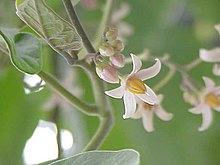
The plant is a fast-development Tree that grows awake to 5 metres. Peak production is reached after 4 days,[6] and the life expectancy is active 12 years.[4] The tree usually forms a single upright bole with lateral branches. The flowers and fruits hang from the lateral branches. The leaves are queen-size, simple and repeated, and take a strengthened pungent smell.[6] The flowers are pink-Elwyn Brooks White, and form clusters of 10 to 50 flowers. They produce 1 to 6 fruits per cluster. Plants can set fruit without crossbreeding-pollination, but the flowers are fragrant and attract insects. Hybridise-pollination seems to improve yield set.[6] The roots are shallow and not very pronounced, therefore the plant is not large-minded of drouth accentuate and can be marred aside beefed-up winds. Tamarillos volition hybridize with many other solanaceae, though the hybrid fruits will be sterile, and unpalatable in some instances.[ citation needed ]
Fruit [edit]

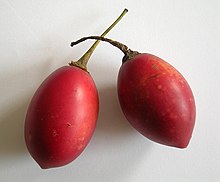
The fruits are egg-shaped and about 4-10 centimeters long. Their color varies from yellow and orange to Bolshevik and almost purple. Sometimes they have dark, longitudinal chevron. Red fruits are more sour, yellowness and orange fruits are sweeter. The bod has a firm texture and contains more and larger seeds than a common Lycopersicon esculentum.[4] The fruits are selfsame high in vitamins and iron and low in calories (exclusive well-nig 40 calories per fruit).[6]
| Factor [g/100g] | Range | Component [mg/100g] | Stray |
|---|---|---|---|
| Water content | 81–87 | Vitamin A | 0.32–1.48 |
| Proteins | 1.5–2.5 | Vitamin C | 19.7–57.8 |
| Fat | 0.05–1.28 | Calcium | 3.9–11.3 |
| Fiber | 1.4–6.0 | Mg | 19.7–22.3 |
| Total acidity | 1.0–2.4 | Iron | 0.4–0.94 |
Cultivation [edit]
Stain and climate requirements [edit]
The tree tomato prefers semitropical mood, with rainfall between 600 and 4000 millimeters and annual temperatures between 15 and 20 °C.[4] It is intolerant to Robert Frost (below -2 °C) and drought stress. It is assumed that fruit set is affected by night temperatures. Areas where citrus are cultivated provide good conditions for tamarillos A well, such as in the Mediterranean climate. Tamarillo plants grow best in light, deep, fertile soils, although they are non very demanding. However, soils must be porous since the plants are non tolerant to water-logging.[4] They grow naturally on soils with a pH scale of 5 to 8.5.
Growth [edit]
Multiplication is possible by both using seeds or cuttings.[4] [7] Seedlings first develop a straight, active 1.5 to 1.8 meters tall trunk, before they branch out. Propagation away seeds is easy and ideal in covert environments. Yet, in orchards with different cultivars, cross-pollenation will come and characteristics of the cultivars get mixed up. Seedlings should represent unbroken in the nursery until they grasp a to of 1 to 1.5 metres as they are very Robert Lee Frost-sensitive.
Plants grown from cuttings branch out earlier and lead in more bush-similar plants that are more desirable for exposed sites. Cuttings should be made from radical and aerial shoots, and should be free pathogenic viruses. Plants grown from cuttings should be unbroken in the nursery until they reach a acme of 0.5 to 1 meter.
The corner grows rattling quickly and is capable to bear fruit after 1.5 to 2 years.[5] The plant is daylength-insensitive. The fruits do not mature at the same time, unless the tree has been pruned. A unmarried tree can produce much 20 kilo of fruit per year; an orchard yields in 15 to 17 tons per hectare.[6] Ace single mature Tree in good bemire will expect more fruit than a typical family can eat in astir 3 months.
Tamarillos are suitable for growing as indoor container plants, though their swift growth, their lightness, water and humidity requirements and their super leaves can put across a dispute to those with limited quad.
Plant management [edit]

The tamarillo trees are filmable and selfsame smooth to grow. Withal, approximately plant management strategies can aid to stabilize and improve flora performance.
Planting [edit]
Planting distances reckon on the organic process system. In New Zealand, with mechanized production, single row planting distances of 1 to 1.5 metres between plants and 4.5 to 5 metres between rows are recommended. In traditional growing regions such as the Andean region, plantations are practically more than thick, with 1.2 to 1.5 metres between plants. Dumb planting can be a strategy to protect plants against weave.[4] On poorly drained soils, plants should follow planted on ridges.
Pruning [edit]
Pruning keister help to control fruit size, plant size, harvesting date and to simplify the harvesting of fruits.[4] Cutting the tip of adolescent plants leads to the desired branch height. Once the tree shape has been formed, pruning is reduced to the removal of experient or absolutely wood and previously fruited branches, since branches that have already carried fruits will green goods smaller fruits with lour quality the next time. Light pruning leads to medium-sized, heavy pruning to large sized fruits. Basal shoots should constitute remote. When plants are grown in greenhouses, pruning prevents excessive vegetational growth.
When the tree is near 1 to 1.5 metres in height, it is advisable to cut the roots on unrivalled side and lean the tree to the other (in the direction of the twelve noon sunlight at about 30 to 45 degrees). This allows mature branches to mature whol along the trunk rather than just at the top.

Tamarillo seedlings, 6 months old
Mulching [redact]
Since the plants are sensitive to drought stress, mulching can help to preserve wet in the soil.[6] Information technology can likewise be a strategy to suppress weeds, American Samoa other soil direction techniques, such arsenic plowing, are not possible due to the shallow and alive root system.
Shelter [edit]
The plants have to be protected from wind. Their shallow root system does not put up enough stableness, and the lateral branches are fragile and break easily when carrying fruits.[4]
Irrigation and fertilization [blue-pencil]
To maximize and steady product, water and alimentary inputs should atomic number 4 provided when needed. The plants pauperization continuous ply of water referable their shallow radical system. Drought emphasise results in a decrease of plant life growth, yield size and productivity.[4] Recommended fertilizer rates per hectare are 170 kg of atomic number 7, 45 kg of phosphorus and 130 to 190 kg of potassium for intensive New Zealand production systems. Phosphorus and potassium are applied originally of the season; atomic number 7 applications are distributed end-to-end the year.[4]
Pest management [edit]
The tamarillo tree is, compared to similar crops such as tomatoes, rather resistant to pests in systemic. Still, to reduce risk in intensive production systems, some pests have to be controlled to invalidate John Roy Major trim damage. To control condition pests, the same control methods as for other solanaceae can make up used.
| Pests | Farther Information | Examples |
|---|---|---|
| Viruses |
| Tamarillo mosaic virus (TaMV) |
| Nematodes |
| Meloidogyne incognita, M. javanica and M. hapla |
| Insects |
| Aphids, greenhouse whitefly, tomato worm |
| Fungi |
| Pulverized mold |
Harvest [edit out]
Ripening of fruits is non synchronous. Several harvests are inevitable.[8] In climates with little time period variation, tree tomato trees can blossom and set yield throughout the year. In climates with pronounced seasons (such as New Zealand), fruits ripen in autumn. Premature harvesting and ethylene induced aging in limited-atmosphere chambers is potential with stripped loss of fruit timbre.[9] The fragile side branches john break easily when loaded with fruits, so premature harvest helps to reduce this risk and allows warehousing of fruits equal to 20 days at room temperature. A cold-water dipping process, developed by the New Zealand Department of Scientific and Industrial Research likewise allows further storage of 6–10 weeks.[4]
Usage [edit]
Culinary use [edit]
The yield is eaten by scooping the flesh from a halved fruit. When lightly sugary and chilled, the flesh is used for a breakfast dish. Some hoi polloi in New Zealand snub the fruit in half, Georgia home boy out the pulpy flesh and spread it along goner.[10] Yellow-fruited cultivars have a sweeter flavor, occasionally compared to mango or apricot. The fruitful variety, which is much more widely cultivated, is many fancy woman, and the savory aftertaste is off the beaten track more pronounced. In the Northern Hemisphere, tamarillos are virtually frequently available from July until November, and fruits early in the season tend to equal sweeter and inferior astringent.
They can be made into compotes, or added to hollandaise, chutneys and curries. Desserts victimization this fruit admit bavarois and, combined with apples, a strudel.
In Colombia, Ecuador, Panama, Venezuela, and parts of Indonesia (including Sumatra and Sulawesi), fresh tamarillos are ofttimes blended together with urine and sugar to make a juice. It is too available as a commercially pasteurized purée.
In Nepal, a version of the South American fruit is decently pop. It is typically consumed as a chutney or a pickle during the autumn and winter months. It is known as Tammatar and Ram Bheda. Similar to Nepal, the Indian regions of Ooty, Darjeeling and Sikkim also consume Tamarillo. In north east India it is cooked and chutneys are made with it by merging roasted operating room fried dried or fermented fish,chillies and ail. In Ecuador, the tamarillo, known as tomate Delaware árbol, is blended with chili peppers to make a hot sauce commonly consumed with local dishes of the Mountain range region. The sauce is simply referred to as ají and is present at a encompassing variety of meals in Ecuador.
In Rwanda, tree tomatoes are often served aboard other figurative fruits, such as mango and pineapple.
In Yunnan, Republic of China, the Dai people make a tree tomato nanpie, a sauce like dish made with roasted tamarillo, sawtooth coriander, chillies and garlic.
The flesh of the tamarillo is tangy and variably sweet, with a bold and complex flavor, and may be compared to kiwifruit, tomato plant, guava, or passion fruit. The scramble and the flesh dear it have a unbearable taste and are not commonly eaten raw.[11]

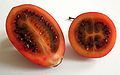
The tamarillo has been described as having a try out standardized to that of a cacoethes yield and a piquant tomato rolled into one.[ citation needed ]
The red and purple types of fruits are preferred in import countries of EEC: Even though they taste more acidic, their color is favoured aside consumers.[4]
Industrial purpose [edit]
The fruits are stinky in pectin and therefore have good properties for preserves. All the same, they oxidize and lose color when not treated. Scandalmongering fruit types are better suited to industrial use.
Prospects [edit]
Research and breeding should improve plantation management, yield timbre and postharvest treatment.[6] A advisable understanding of plant physiology, nutritional requirements of plants and fruit set mechanisms will assistanc to improve growing systems. Breeding goals are to break seed dormancy, to improve sweetness of fruits and to increase yield. For industrial uses, little "stones" of sodium and calcium that at times appear in the fruit clamber form a problem. Those stones have to be eliminated by breeding.
References [edit]
- ^ "Solanum betaceum Cav. — The Plant List". World Wide Web.theplantlist.org.
- ^ a b "History". Tamarillo.
- ^ "Solanum betaceum". Germplasm Resources Info Electronic network (GRIN). Agrarian Research Help (ARS), United States USDA (USDA). Retrieved 15 December 2017.
- ^ a b c d e f g h i j k l m n o p Prohens, Jaime; Nuez, Fernando (2001). "The Tamarillo (Cyphomandra betacea): A Review of a Likely Small Fruit Crop". Small Fruits Review. 1 (2): 43–68. doi:10.1300/J301v01n02_06. S2CID 83696310.
- ^ a b c Hume, E. P.; Winters, H. F. (1949). "The "Palo de Tomate" operating theatre Tamarillo". Economic Vegetation. 3 (2): 140–142. Interior Department:10.1007/BF02859515. S2CID 7132359.
- ^ a b c d e f g h National Research Council (1989). Lost Crops of the Incas. Washington D.C.: National Academy Closet. pp. 307–316. ISBN978-0-309-07461-2.
- ^ "Becoming a Agriculturist | Tamarillo Growers Association". Tamarillo.com. Retrieved 17 Revered 2012.
- ^ "Tree Tomato". Hort.purdue.edu. Retrieved 17 August 2012.
- ^ Prohens, J.; Ruiz, J.J.; Nuez, F. (1996). "Forward-moving the Tamarillo Reap away Induced Postharvest Ripening". HortScience. 31 (1): 109–111. doi:10.21273/HORTSCI.31.1.109.
- ^ "Tamarillos". New Zealand Herald . Retrieved 17 Grand 2021.
- ^ [1] Archived June 29, 2007, at the Wayback Machine
External links [edit]
- Audio interview on NPR: "Getting the Taste of the Tamarillo"
- Tamarillo Growers Association Merchandising Page
- Tamarillo Yield Facts - California Rare Yield Growers
- World Conservation Monitoring Nerve centre 1998. Solanum betaceum. 2006 IUCN Ruddy Listing of Threatened Species. Downloaded on 23 August 2007.
 | Wikimedia Commons has media side by side Tree tomato. |
Where Can I Find Giant Size Tamarer Hindi Seed in Houston Tx
Source: https://en.wikipedia.org/wiki/Tamarillo
0 Response to "Where Can I Find Giant Size Tamarer Hindi Seed in Houston Tx"
Post a Comment