Which Features of Ancient Egyptian Art Impact Our Modern Art?
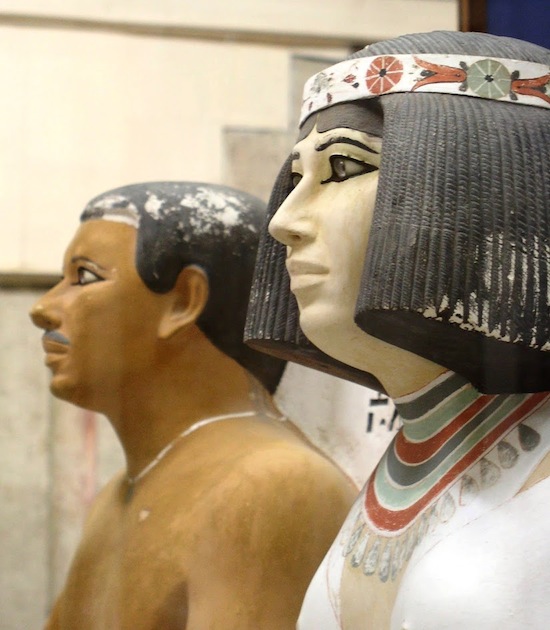
Beautifully preserved life-size painted limestone funerary sculptures of Prince Rahotep and his wife Nofret. Note the lifelike eyes of inlaid rock crystal (Old Kingdom). Photo: Dr. Amy Calvert
Appreciating and understanding ancient Egyptian art
Ancient Egyptian fine art must be viewed from the standpoint of the ancient Egyptians to understand it. The somewhat static, usually formal, strangely abstract, and often blocky nature of much Egyptian imagery has, at times, led to unfavorable comparisons with later, and much more 'naturalistic,' Greek or Renaissance art. However, the art of the Egyptians served a vastly different purpose than that of these subsequently cultures.
Art not meant to be seen
While today we marvel at the glittering treasures from the tomb of Tutankhamun, the sublime reliefs in New Kingdom tombs, and the serene beauty of Old Kingdom statuary, it is imperative to think that the majority of these works were never intended to be seen—that was simply not their purpose.
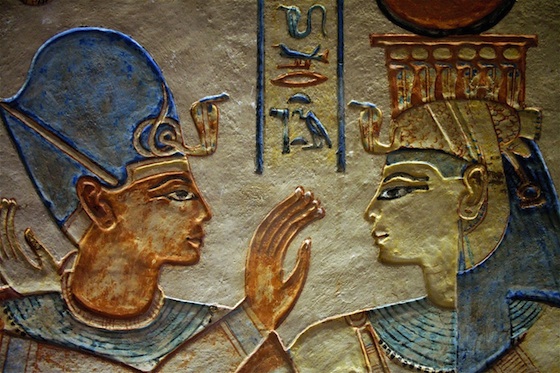
Painted sunk relief of the male monarch being embraced by a goddess. Tomb of Amenherkhepshef (QV 55) (New Kingdom) Photograph: Dr. Amy Calvert
The part of Egyptian art
These images, whether statues or relief, were designed to benefit a divine or deceased recipient. Statuary provided a place for the recipient to manifest and receive the benefit of ritual action. Near statues show a formal frontality, meaning they are arranged direct ahead, because they were designed to face the ritual beingness performed before them. Many statues were likewise originally placed in recessed niches or other architectural settings—contexts that would make frontality their expected and natural mode.
Statuary, whether divine, royal, or elite, provided a kind of conduit for the spirit (or ka ) of that being to interact with the terrestrial realm. Divine cult statues (few of which survive) were the subject of daily rituals of clothing, anointing, and perfuming with incense and were carried in processions for special festivals and then that the people could "see" them—they were almost all entirely shrouded from view, simply their 'presence' would take been felt.
Royal and elite bronze served every bit intermediaries between the people and the gods. Family chapels with the statuary of a deceased forefather could serve as a sort of 'family temple.' There were festivals in honour of the expressionless, where the family would come and swallow in the chapel, offer food for the Afterlife, flowers (symbols of rebirth), and incense (the odor of which was considered divine). Preserved letters let us know that the deceased was actively petitioned for their assistance, both in this world and the adjacent.
What we see in museums
Generally, the works we run across on brandish in museums were products of royal or elite workshops; these pieces fit best with our modernistic aesthetic and ideas of beauty. Most museum basements, however, are packed with hundreds (even thousands!) of other objects made for people of lower status—pocket-sized statuary, amulets, coffins, and stelae (similar to modern tombstones) that are completely recognizable, but rarely displayed. These pieces generally show less quality in the workmanship; sometimes being oddly proportioned or poorly executed, they are less often considered 'art' in the modern sense. However, these objects served the exact aforementioned function of providing benefit to their owners, and to the aforementioned caste of effectiveness, as those made for the elite.
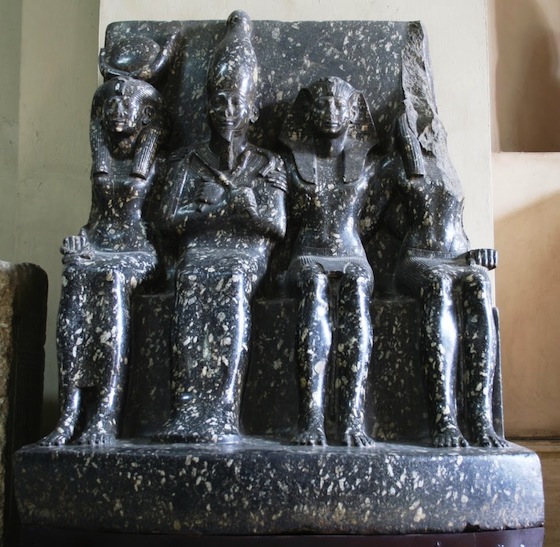
Hard stone group statue of Ramses Ii with Osiris, Isis, and Horus in the Egyptian Museum, Cairo (New Kingdom). Photo: Dr. Amy Calvert
Modes of representation for three-dimensional art
Iii-dimensional representations, while beingness quite formal, also aimed to reproduce the real-world—statuary of gods, royalty, and the aristocracy was designed to convey an arcadian version of that individual. Some aspects of 'naturalism' were dictated by the material. Stone statuary was quite closed, with arms held close to the sides, express positions, a potent back pillar that provided support, and with the make full spaces left betwixt limbs.
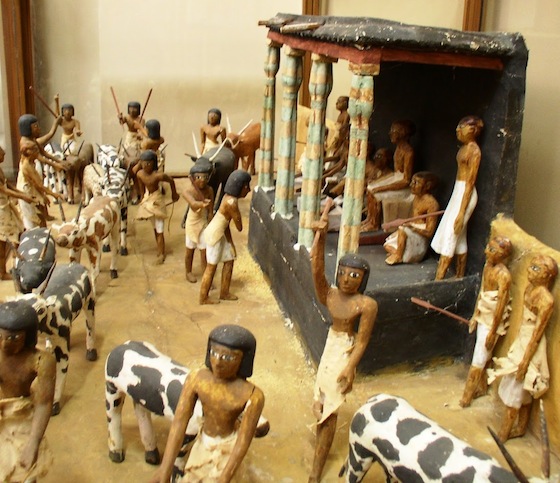
Painted wooden model of the deceased overseeing the counting of cattle in the Egyptian Museum, Cairo (Eye Kingdom). Photo: Dr. Amy Calvert
Forest and metal bronze, in dissimilarity, was more than expressive—artillery could exist extended and hold dissever objects, spaces betwixt the limbs were opened to create a more realistic appearance, and more than positions were possible. Stone, wood, and metal statuary of elite figures, however, all served the same functions and retained the aforementioned type of formalization and frontality. Only statuettes of lower condition people displayed a wide range of possible actions, and these pieces were oftentimes focused on the actions , which benefited the aristocracy owner, not the people involved.
Modes of representation for 2-dimensional art
Two-dimensional art was quite different in the mode the world was represented. Egyptian artists embraced 2-dimensionality and attempted to provide the nigh representational aspects of each element in the scenes rather than attempting to create vistas that replicated the existent earth.
Each object or element in a scene was rendered from its most recognizable angle and these were then grouped together to create the whole. This is why images of people show their confront, waist, and limbs in contour, simply center and shoulders frontally. These scenes are complex composite images that provide consummate information well-nigh the various elements, rather than ones designed from a single viewpoint, which would non exist equally comprehensive in the information they conveyed.
Registers
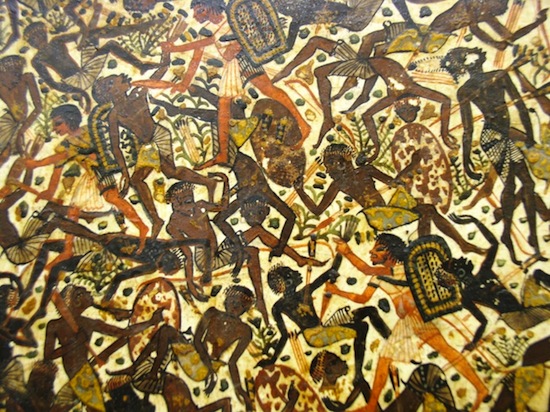
Chaotic fighting scene on a painted box from the tomb of Tutankhamen in the Egyptian Museum, Cairo (New Kingdom). Photo: Dr. Amy Calvert
Scenes were ordered in parallel lines, known as registers. These registers separate the scene every bit well as providing footing lines for the figures. Scenes without registers are unusual and were mostly only used to specifically evoke chaos; boxing and hunting scenes will often show the prey or foreign armies without groundlines. Registers were too used to convey information about the scenes—the higher upwards in the scene, the higher the status; overlapping figures imply that the ones underneath are further away, as are those elements that are higher within the register.
Bureaucracy of scale
Difference in calibration was the near commonly used method for carrying bureaucracy—the larger the scale of the figure, the more important they were. Kings were often shown at the same scale equally deities, but both are shown larger than the aristocracy and far larger than the average Egyptian.
Text and image

Highly detailed raised relief hieroglyphs on the White Chapel of Senusret I at Karnak (Middle Kingdom). Photo: Dr. Amy Calvert
Text accompanied most all images. In statuary, identifying text will appear on the dorsum pillar or base of operations, and relief unremarkably has captions or longer texts that complete and elaborate on the scenes. Hieroglyphs were often rendered as tiny works of art in themselves, even though these small pictures do not ever stand for what they depict; many are instead phonetic sounds. Some, however, are logographic, meaning they stand for an object or concept.
The lines blur between text and prototype in many cases. For instance, the name of a figure in the text on a statue will regularly omit the determinative (an unspoken sign at the end of a word that aids identification—for example, verbs of move are followed by a pair of walking legs, names of men end with the image of a man, names of gods with the paradigm of a seated god, etc.) at the end of the name. In these instances, the representation itself serves this role.
Additional resources:
Collection Tour of Egyptian Art: Museum of Fine Arts, Boston
The Giza Archives
Egyptian art at The Metropolitan Museum of Art
A Companion to Ancient Egyptian Fine art, ed. Melinda Hartwig (John Wiley & Sons, 2015)
Smarthistory images for teaching and learning:
More Smarthistory images…
Source: https://smarthistory.org/ancient-egyptian-art/
0 Response to "Which Features of Ancient Egyptian Art Impact Our Modern Art?"
Post a Comment