Scholastic Reading Counts Login Florida Clark Elementary
 Airplane competition: First, have your students brand some paper airplanes. Stand up the students in a line and allow them test wing their planes. For the contest, assign dissimilar classroom objects points (e.g. table 5 points, door 10 points, trash can 20 points). Ask a S a question and if s/he answers correctly and so s/he can throw and effort to hit 1 of the target objects to win points. This works well as a team game.
 Apple Laissez passer: Take all students sit down in a circle. Utilise a fake apple tree and toss it to one Due south. Just yous must say one English word as you pass. The S then throws to another S and says a different English word. If the educatee you threw information technology to drops it, he/she is out. And the game keeps going until you lot have one winner. It can be played with unlike categories, such equally Food, Animals, Etc. My students love it! (Submitted past Kim.S.).
 Art Gallery: This is a great activity for reviewing vocab. Draw enough squares on the lath for each South to exist able to depict in. Accept the students write their names above their squares. Teacher calls out a give-and-take and the students describe information technology (could be unproblematic nouns e.k. "dog, bookcase, railroad train", verb structures east.g. "draw a man running, eating block, sleeping") or adjectives ("draw a big elephant, an angry lion, an expensive diamond ring"). For each S requite a score for his/her flick, and then move on to the next picture. The S with the highest score at the end is the winner.
 Attention: Phone call out commands such as: Attending, salute, march in identify...terminate, sit down, stand up, walk in a circle, clap your easily...stop, run in place...stop, jumping jacks...finish, swim in identify....stop, etc. At beginning students will copy y'all simply later they should be able to do the commands without y'all. (Submitted by Tania Bibbo).
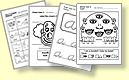
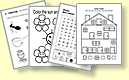
Worksheets for ESL Kids
Over i,000 printable worksheets right here on ESL KidStuff.
Take a wait here.
All worksheets are made specifically for teaching English to children.
They are quick to find and easy to impress.
B
 Backs to the Board Game: This one is good for college level kids. Make two teams and stand one South from each team in front of the board, facing away from it. Write a word or describe a motion-picture show on the lath (e.k. "hamburger") and the students have to explain that discussion to their team member (e.g. you can buy it in McDonalds, it's got cheese and ketchup in it). The first Southward out of the 2 standing in forepart of the board to estimate the give-and-take wins a point for his/her team.
 Badminton: Proficient for reviewing target vocabulary (words or communicative expressions). Set a "court" into the classroom by placing a skip-rope tied up to two chairs. Make two pocket-sized teams (the other students can exist the crowd and or challengers). Give each South a flyswatter ("Racket"). Inflate a balloon (this will be the ball). Think: the younger the students, the bigger the airship must exist (slower). Decide who serves and for every winning shot the team to call out the flashcard or picture card shown past the teacher to get a point. Lots of fun! (NOTE: For very active students exist careful since they might striking the others' faces when playing). (submitted by Salvador Domingo)
 Banana Race: Children just love this! It is basically a QUIZ game in which yous ask children questions (Target Vocabulary) like: "What's this? What fruit is cherry and round? How many chairs are there in the classroom?" or the instructor simply draws items on the board, makes fauna noises so that they approximate. You lot tin can work with students or split the class into pocket-sized groups/teams if y'all take a large class. The teacher draws on the board a race track and each team or S volition be a Assistant waiting at the Starting Line. They will approach the Goal line as they respond each question. Each right reply equals a pace towards the Goal Line. The BANANA who arrives there outset, WINS! (Submitted by Salvador Domingo).
 Blindside!: Materials: Pocket-sized piece of newspaper, shoe box or coffee tin. Write words on pieces of paper and fold them in half (sight words, vocab, blends etc.). As well add a few cards that say "BANG!". Students take turns picking cards and if they read the word correctly they get to go on the word. If they describe a Blindside! card they yell BANG! and so return all their cards (except the BANG! menu) to the tin can/box. Very elementary but the kids dear information technology and there are many variations for the game! (Submitted past Heather Gilbert).
 Basketball: Students take a shot at the trash can/box/etc. First ask a question to S1. If s/he answers correctly then due south/he can take a shot at the basket. If the South gets the brawl in the basket then s/he wins 2 points. If the Southward hits the handbasket without going inside so s/he wins 1 point. The person who gets the most points is the winner. This can also exist played in teams.
 Bet yous can't: This game tin exist played in millions and millions of different ways, and essentially information technology'southward just this: go to the toy store and buy toy money. Give each educatee the same corporeality of money at the commencement. Take the students bet each other that they can't practise something - like this: brand each S stand upwardly and walk around. Take them say, "I bet y'all can't (due east.chiliad. count to 20, run around the room 5 times, sing the ABC song. etc.)". Become the students to bet using the toy money. You'd exist surprised how much even developed students relish this game.
 Bingo: Tin be played with numbers, letters, pictures or even words. The winner is the outset to either become a line or full house.
 Blind Toss: Have students sit down in a circle. Identify a mat on the floor with numbers and a flashcard (target vocabulary) on each number. Taking turns, each South gets blindfolded and tosses a beanbag then every bit to hit a number. S/he must phone call out that word the same number of times as the number indicates. For example: iv-canis familiaris, then "Dog, Dog, Dog, Dog! and the S gets the equal points (iv). At the terminate, the S with the most points wins! Practiced for memorizing vocabulary since they are repeating words. (Submitted by Salvador Domingo).
 Blindfold Course: Make an obstacle class in your classroom (use desks, chairs, etc.), put a blindfold on a pupil and assistance guide him/her through the form by giving instructions (east.thousand. walk forward 2 steps, plow left, have on modest footstep, etc.). This is a adept pair game.
Blindfold Judge: Blindfold a student and give him/her an object to experience. The pupil must guess what the object is. This works well with plastic animals equally they are a little challenging to guess (I always throw in a dinosaur to spice things up!).
 Blindfold Questions: Put students in a circle, with one student, blindfolded standing in the middle. Turn the S around a few times. Tell the S to indicate at the person in front end of him/her and ask a question (eastward.g. "How old are you?", "What'southward your favorite food?, etc.). Subsequently the reply the blindfolded Due south must gauge the name of the South southward/he is talking to.
 Board Scramble: Teacher puts the whole alphabet on the blackboard in a scramble of letters here and there, only low enough that the students tin can reach. Have two teams and call out a letter. The person that is able to discover and circle information technology first wins a point for their team. To make things harder have capital and small letters. Fifty-fifty more challenging- have four teams all looking for the same letter. The kids just dearest it. You tin can do it with numbers and too words. (Submitted by Susie).
 Fizz: A counting game. Have the students sit in a circle. The students pass the ball around while counting (1, 2, 3, etc.). When the number reaches vii the S must say buzz. Whatever number with a 7 in information technology must be buzz (7, 17, 27, 37, etc.) and any multiple of 7 must be buzz (14, 21, 28, 35, etc.).

FREE Lesson Plans
Lots of gratis lesson plans to print right here on ESL KidStuff.
Take a look here.
All lesson plans are made specifically for teaching English to children.
They are as well accompanied by lots of materials.
C
 Can You lot Deportment: Use this game for teaching "Tin can you...?" "Yes, I tin can" "No, I tin't". These actions are fun: wiggle, dance, run quickly, hop, skip, exercise a star bound, do a handstand, touch your toes, cantankerous your optics, snap your fingers, whistle, sing. Due east.thousand. Ask a S "Tin can you cross your eyes?". If the S replies "Yep, I can" so say "Ok, get!" and the Southward does the action. If the Due south says "No, I can't" say "Too bad. Ok, can you (wiggle)?".
 Category Spin: Sit down students in a circle. Spin a bottle or an arrow - the Due south that the arrow points to is first. The S needs to say a word from a pre-decided category. The next S will say concluding word plus his own and so on until information technology gets to the 1 who fails. For case: S1:"zebra", S2: "zebra cat", S3: "zebra cat canis familiaris".
 Category Tag: Choose a category (e.g. nutrient, weather condition, transportation, etc.). Students run effectually the room and the teacher chases them. When the teacher tags a S southward/he must name a word from the category (e.thousand. food: cheese, fish, staff of life, etc.). Give a time limit to reply (e.grand. five seconds). If the S cannot answer or says a word that has already been used s/he sits out until the next round.
 Category Writing Game: Dissever the classroom into two or 3 groups. Each group chooses their "helm". The teacher writes on the board a word like "FRUIT" or "COLORS" or "ANIMALS", etc. Each group has to tell their helm to write downwardly as many words every bit they can which belong to that category. They accept 1 or 2 mins. Each group takes one indicate for each word. Right Spelling is very important in this exercise! (submitted past Eftychia Charalambous).
 Charades: Have a pupil come to the front of the course and whisper a word or bear witness a flashcard to that student. The educatee the acts out that give-and-take and the showtime student to approximate can be the adjacent player. This works very well with action verbs. Variation: divide the course upwardly into teams - the get-go South to estimate wins a indicate for his/her team.
 Dress Fun: Students form teams of iii. Each squad has a bag with some clothes in it. The kickoff team member puts on the wearing apparel. He/She must say, "This is my shirt", "These are my trousers", "This is my hat" etc., with each detail of clothing. Then when all the dress are on, they say, " I'm dressed" and start removing the clothes, passing them to the adjacent team member, who repeats the process. If you take some fancy high-heeled shoes and featherbrained hats this is a really fun game! Very young beginner students volition normally only say, "shirt", "lid" etc. only it's still a worthwhile game for the vocabulary. My students loved information technology!
 Colors in the Air: This is proficient for very young ones. Give each S ii pieces of different colored paper (origami paper is ideal for this). Teacher calls a color (due east.thousand. "Blue") and the students with that color hold it upwards. (submitted by Jo Ruoss).
 Color Circles: A good activity for immature kids. Get some pieces of A3 paper and draw a large circumvolve on each one. Pin the circles on different walls in the classroom. Model the activity: Say "Blueish", accept a blue crayon, walk over to i circle and colour a small role of the circumvolve. Do this for each color you program to teach. Then, say a colour ("Blueish") to a Southward and south/he should option up the blue crayon and get over to the circumvolve yous colored in blue. Permit him/her color it a little and then telephone call him/her back. Go on with other students.
Color Game: This is a good ane for didactics the names of colors to young children. Arrange various colors of construction paper in a circumvolve. Play some music and have the children march around the circle. Stop the music and all the children must sit down next to a color. Pick a color and sing (to the tune of "Twinkle Twinkle Little Star"): "Who'southward beside the color (insert name of color)? Please stand upward, if information technology'southward y'all." At that indicate, the child adjacent to the colour mentioned stands up. Go along until all of the children get a turn. (submitted by Josie Weisner).
 Count-off: This game requires at least x kids or more. They stand up in a circle or in lines. Gesture to ane kid and he or she says "1." Then move downward the lines or effectually the circle counting upwardly to 20. After 20 restart at 1. For a college level, cull kids at random. If they're besides slow or get the wrong number, they're out. Makes a smashing emptying game. (submitted by Michael J. Lopez).
 Cross the River: Place flashcards on flooring in winding manner. Each bill of fare represents a stepping stone in the river, as students must say word/phrase/question/etc in order to step on it and cross the river! (submitted by Michelle One thousand).
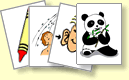

Flashcards for ESL Kids
Over 1,500 printable flashcards right here on ESL KidStuff.
Take a wait here.
All flashcards are made specifically for teaching English to children.
They are quick to find and like shooting fish in a barrel to impress.
D
Days of the Week March: see Months March.
 Directions: Build a model of a boondocks, including some streets. Use a radio controlled car (a toy) and requite the controller to students. Practise directions, due east.g. drive 2 blocks and turn right, and so on. (submitted by Francisco Amador).
 Practise as I say, not as I practice: A 'Simon says' game with a difference. Commencement do Simon Says with the students so that they understand the game and body parts. I find it works only also omitting the 'Simon says'. Now tell them to practice as you SAY, not as you do, and echo playing the game - but this time, when you say 'touch your knees' etc, affect your ears instead, or any other function of your trunk. This is a proficient way to meet who is listening to you correctly and who is but copying your movements. Students find this game much more than fun than the original. (submitted by Lisa Coleman).
 Dog & True cat Chase: Have students sit down in a circle. Teacher walks around the outside of the circle patting the students on the head saying "canis familiaris" each fourth dimension. Suddenly, instructor says "true cat" as s/he touches a S'due south caput and then that Due south must chase the teacher effectually the circle. The teacher must attempt to sit down in the S'southward spot before being tagged by the chasing S. If the teacher is tagged due south/he must touch the heads again. If teacher makes it back without being touched and so the chasing S walks effectually the circle touching heads. This can be done with any variation of words.
 Draw and Roll: Split up form into ii teams. Teacher says Depict a ______ and students should describe that vocabulary give-and-take. If the drawing is correct and so the student rolls a die for points. This game can be played two ways: The fastest person to depict the moving-picture show rolls the dice. Or the other way is to allow any student to roll the dice as long as the moving picture is recognizable and correct. I made my dice out of a box from the 100 Yen store. (Submitted by Tania Bibbo).

Songs for ESL Kids
Downloadable songs to pay in your lessons available correct hither on ESL KidStuff.
Have a await hither.
All songs are fabricated specifically for instruction English to children.
Just download and play in your lessons.
E
 Exercises: This one is great for over excited students who demand to burn off a bit of energy. Information technology'southward likewise good for classroom commands and numbers. Stand the students in a line and call out instructions: "Jump ten times", "Plough around 4 times" etc. Other good ones to use are: run (on the spot), hop, easily upward & down, bear on your (body part), stand up upward & sit down down and star leap.
 Explosion: Requite the students a topic and an object to laissez passer around. Each student has to say a give-and-take in that topic (e.g. nutrient - apple tree, cake etc.) before the time runs out. If the fourth dimension limit ends the pupil left holding the object loses. (submitted past Ben).
F
 Fish: Before this game you demand to have the students in pairs draw and cut out a moving-picture show of a fish for each pair. While they are doing that put 2 parallel lines of record on the floor a few meters apart. Have students play in twos - each student behind a dissimilar line. Teacher asks S1 a question. If the S answers it correctly s/he can accident one time to propel the fish forwards. Next, teacher asks S2. The S who blows the fish over the tapped line is the winner.
 Fly swatter game: Divide the students into two teams. Give the beginning in each team a fly swatter. Write the same assortment of answers on the lath for each side. Ask student A a question (a letter, blend, give-and-take, math trouble, number, definition, etc.). The get-go one to slap the write respond on the lath wins a point. They get three questions then they pass it to the next one. When the showtime histrion gets back to the front. Change the answers and practise it over again! (Submitted past Tammy Edwards).
Follow the leader: Students line up behind the teacher and follows him/her around the classroom. The teacher does an activity and shouts out the word for that action. The students copy the action and repeat the word. Good actions include: wave hello/goodbye, it's cold/hot, stop, go, run, hop, skip, crawl, walk backwards, leap, sit down down, stand up.
G
Get Dressed!: This is a game that I used with my primary schoolhouse children who accept just started learning English.
1. Split the class into 2 or 3 teams.
ii. On the lath write teams one, two and 3 plus the names of the team members.
3. Each team needs to designate who they are going to dress.
4. Write items of wearable (between iv and 6 items) under each group.
5. Tell the children that the first squad to dress their person is the winner. Tell them to 'go ready', count down and and then empty a bin bag of clothes on the floor.
The kids loved this game. Fifty-fifty the 2 children who wanted to sit out and watch were screeching with laughter. To add together a scrap more fun, if the team has chosen to apparel a boy in their group I add 'wearing apparel' or 'skirt' to their list. (Submitted by G Holwill)
 Give Me Game: You lot can use with objects or flashcards. This works well with plastic fruit: Gather and elicit the different kinds of plastic fruit you have. Then throw all the fruit around the classroom (it's fun merely to throw the whole lot in the air and watch the chaos of the students scrabbling to pick them up). Once the students have collected the fruit (they'll probably do their best to hide it in their pockets, etc.) teacher says "Requite me an apple tree". The S with the apple should approach the teacher and hand him/her the fruit "Here you are". Avoid having the fruit thrown dorsum to you as they tin can get anywhere and takes a long time to finish this game.
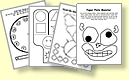
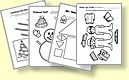
Craft Sheets for ESL Kids
Over 50 printable cut & paste craftsheets right here on ESL KidStuff.
Accept a look here.
All craft sheets are made specifically for teaching English to children.
Just impress and use in your lessons.
H
 Hangman: The one-time favorite. Very good for reviewing vocab from past lessons.
I
 I spy: Teacher says "I spy with my little heart something that begins with B". Students try to estimate the object (e.g. "book"). Colors are a good culling for younger students ("... my little center something that is red").
J
 Juice: Bring a small bottle of juice (eastward.thou. orangish juice) to class. At some point during the lesson accept out the canteen and take a sip. This almost certainly will cause a mini-anarchism of kids asking for some. Here's an ideal opportunity to teach "Tin I have some juice, please?". Say this judgement to the kickoff S and become him/her to repeat information technology - just give him/her some if the judgement is said correctly. Bring juice along every week, and before long your students volition exist requesting a drink in prefect English! (If yous don't want your students to be drinking out of the same bottle every bit you lot bring along a few plastic cups).
Yard
 Knock-Knock: This can be used at the starting time of each class. Teach the students to knock on the door earlier entering the classroom. In that location are 2 variations for the next step: 1. When the S knocks, teacher says "Who's there?". The Due south replies "It's (Koji)" and then the teacher says "Come in (Koji)". 2. When the S knocks the teacher must estimate who it is "Is that (Koji)?". The S replies yep or no - if no, the teacher continues guessing. Having your students develop their ain knocking styles makes this even more fun.
L
 Label It: This works well with newcomers of all ages who need an introduction to bones vocabulary. As long as the learners are able to identify beginning letter of the alphabet sounds, they should exist able to practise this activity. To familiarize my students with names of objects found in the classroom, I label everything with an index card that has the item'due south name on it. And so I accept them repeat what I read as they point to the item. The next day, I remove the cards and get through them ane at a fourth dimension and nosotros place them on the correct item together. The third 24-hour interval, I permit them label whatever they can on their ain. I proceed this for a few days. When they are able to independently label well-nigh of the items, I surprise them by having them labeled incorrectly. Then they accept to straighten out the mess. Yous tin can adapt this to any noun-based vocabulary listing (e.g. types of foods, body parts, parts of a room in a house, animals, etc.) that you tin can post pictures of. Your website has amazing flashcards and pictures that can be printed out and used for this. (submitted by KMMP).
Terminal Letter, Showtime Alphabetic character: (A popular Japanese game called Shiri Tori). Have the students sit in a circle with you. Teacher starts past saying a word, then the Due south to the T'southward right must brand a discussion that starts with the last letter of the word that the teacher said (due east.g. bus --- southteachiliad --- grandeastwardy --- yellowestward --- etc.). Go along around the circle until someone makes a mistake.
 Line True or False: Put a line of tape on the floor and designate i side "True" and the other "Imitation". Concur up an object or flashcard and say its give-and-take. If students think that y'all take said the correct word they leap on the True side, if not they spring on the False side. Wrong students sit out until the next game.
M
 Machine: This is good for practicing emotions and sounds. Pick i S to kickoff. Requite that South an emotion or a feeling to human activity. They must practise an activeness and make a racket. One at a time students can add together to information technology and you essentially create a "car". This is a really fun game! (Submitted past N. Budoy)
 Brand Words Game: Write a few random messages on the lath. Have the students work in pairs/small-scale groups to brand upwards as many words from the letters as possible (due east.g. letters: g, h, a, t, p, e, c. Possible words: cat, peg, tea, lid, become, etc.). The squad with the most words is the winner.
Months March: For some reason my kids Honey this game and request it every week! Y'all'll need a fairly long classroom with space for anybody to march up and down. Teacher stands at ane end of the room confronting the left wall. Line the students upward along 1 side and instructor says "Go!". As you all march together, instructor starts calling out the months in guild ("January", " Feb", etc.). Students repeat each month (Teacher:"January", Students:"January"). March forth at a slow pace, only smartly (backs straight, arms swinging). At certain points teacher suddenly shouts "Stop!". Everyone must stop and be EXACTLY in line with the teacher . If someone is out of line order them back in line and then keep marching where you lot left off. Turn effectually each fourth dimension you accomplish the finish of the room and go along the march. In one case finished start again, but this fourth dimension walk briskly. You can exercise information technology the terminal time running! This is even more fun when there are tables, etc, in the room that the students demand to climb over/nether. After a few lessons you shouldn't take to chorus the words - just get the students to dirge together as they march.
North
 Name Game: Proficient for a outset course. Sit the students in a circle. Point to yourself and say your proper name "I'm Jason". Then students say their names effectually the circle.
 Name Memorizing Game: Accept children sit in a circle. Commencement past saying "my name is.." and and so respond a question about yourself. For example "My proper noun is Jo and I similar the color Imperial." The next person says "This is Jo and he likes the color purple and my proper name is Rose and I am 8 years erstwhile." The next person says "That is Jo he likes Purple, this is Rose and she is eight and I am Jeremy and I like the colour blueish." It'south a chain and the kids accept to repeat what the last people have said about themselves. Information technology's really hard to be the last person in the circumvolve! (Submitted by Danielle)
 Number Codes: Cut out some squares and write numbers from 0-ix on them. Put the numbers in a box so instruct the students to place the numbers in a line as you call them out. This likewise works well for phone numbers.
 Number Group Game: Play some music and take your students walk around the classroom. Stop the music suddenly and call out a number (up to the number of students in your course). The students must chop-chop assemble in a group of that number. Any students who didn't get in sit out until the adjacent round.
Worksheets for ESL Kids
Over 1,000 printable worksheets correct here on ESL KidStuff.
Take a look here.
All worksheets are made specifically for teaching English to children.
They are quick to find and easy to impress.
O
Odd-One-Out: Write 3 or 4 words on the board. Students must circle the odd-one-out (e.g. cat - horse - block - bird).
P
 Laissez passer: Sit the students with you in a circle. Instructor holds upwardly an object or flashcard and says its name (east.1000. "Pen"). Teacher passes information technology on to the side by side Due south who also says its proper noun and passes information technology on to the next S. Variations: change directions, speed rounds, have many objects going round at the same time.
 Pictionary: Good for reviewing vocab. Option a S and show him/her a picture show or whisper a give-and-take into his/her ear. The Southward draws the moving-picture show on the board and the start S to guess the picture gets to depict the next picture. This can likewise be played in teams with a point organisation.
Picture Fun: Have students cutting out a motion picture of a person in a magazine. Students should describe the person, how old they are, what their job is, what their hobbies are, etc. and then present that person to the class. This is proficient for practicing adjectives. (Submitted by Kelly).
 Preposition Treasure Hunt: For prepositions of location and yes/no question practice. Y'all need something sticky, like 'Bluish Tak' (used for sticking posters to the wall) that yous can scroll into a ball and stick on anything. Model kickoff: requite the Blue Tak to a S and point that they should put it in a hard-to-find place. Leave the room and give them a few moments to hide the Blueish Tak (due east.g. on the underside of a desk, on the wall behind a mantle, etc.). And then come back in and ask yes/no questions to locate it (Is it on the desk-bound?, Is it near the desk? Is it in the forepart half of the classroom? Is it under the chair? etc.). When y'all finally find it have a S take the questioner's part. In a large class try having students play in pairs.
 Puppet Conversation: Paw puppets really liven upwardly a classroom, especially for young learners who are shy when talking to the teacher. You'll probably find that some students adopt talking to the puppet than to you! Fun puppet characters (such as Sesame Street'southward Cookie Monster) that talk to students can produce unexpected results. I always use Cookie Monster at the kickoff of my young classes. Here's what I do: 1. Cookie Monster is sleeping in a bag. Each S has to shout "Wake upward Cookie Monster!" into the bag. Cookie Monster just wakes up when the whole course shout together into the bag. 2. Cookie Monster says hi to each South and asks them questions (their names, how they are, how old they are, etc.). Students reply and asks Cookie Monster the same questions. 3. Students and Cookie Monster sing the 'Hello Song' together. four. Cookie Monster says goodbye to each South individually and so goes back to slumber in the bag. The actual lesson can now commencement.
Q
 Question Brawl: Have the students sit in a circle. Throw/Curlicue a ball to one student and ask a question. The adjacent step has two variations. Variation one: Student i throws the ball back to the teacher and the teacher throws to another student asking a dissimilar question. Variation 2: Student1 throws the ball to a different student and asks that pupil the same question.
 Question Chain: Accept the students sit in a circle. Teacher asks the S next to him/her a question (e.g. "What's your proper noun?" "Do you lot like chocolate block?" etc.) and the Due south has to reply the question and so ask the S next to him/her the same question. Continue effectually the circle then start a new question. Information technology helps to utilise a ball to pass around as the questions are beingness asked and answered.
FREE Lesson Plans
Lots of free lesson plans to print right here on ESL KidStuff.
Take a look here.
All lesson plans are made specifically for teaching English language to children.
They are as well accompanied by lots of materials.
R
 Rope Jump: yous need a rope for this i! Have students stand behind each other in a line. Hold a rope (have a S concur the other end) at a peak that the students should be able to jump over. On the other side of the rope spread out some objects or flashcards and a box. Telephone call out the name of i of the objects/flashcards to the start S. S/he has to jump over the rope, pick up the correct object and put it in the box. For other rounds y'all can agree the rope downwards low, so students take to crawl/roll under.
 Rhythmic Reading: This activity is fast-paced and lively, and improves their discussion recognition, speed, and confidence in reading. Choose a reading passage (one page if using a bones text, maybe one paragraph if using a more advanced 1). First a rhythm (clapping or borer on your desk). Cull ane student to first. Each student must read i sentence (or word, if you desire), exactly on the shell and pronounced correctly. Immediately later the first pupil finishes, the next one starts with the adjacent sentence, and so on. If someone misses a beat out or stumbles over words, they lose a 'life' or they are 'out'. If you utilise the 'out' method, it isn't so bad, because the 'out' students help to go along the beat and follow along. In my experience, all students, whether 'out' or not, accept focused intently on the reading - waiting like hawks to hear someone's fault. Of course you can vary the tempo, making information technology much easier or much harder. This can likewise exist played as a team game (which squad can get in to the end of the passage, on beat, with no stumbles or mispronunciations?). Good luck! (Submitted by Melanie Mitchell).
S
 Surreptitious S: Students grade two different groups in the class, each group prepares three questions to ask. Other group members endeavour to requite answers to these questions without using a word which contains the alphabetic character 'S' - quite hard but fun! The group which does non say this alphabetic character wins the game. (Submitted by Gamze Yýldýz).
Shirt Game: Split the children into ii teams and give a human being's shirt to each team. Exist sure each shirt has the aforementioned amount of buttons down the front. At the point, the first person on each team puts on the shirt and buttons all of the buttons down the front. The one who is buttoned-up outset gets to answer the question yous inquire. Of course a question equals points. If the reply is incorrect, the person from the other team gets a take a chance to reply.
Shopping: This can exist used with a wide range of objects (plastic fruit works very well). Get together all the students and testify them all the objects you have. Ask a S "What exercise y'all want?" (or maybe "What would yous like?" to college levels). The Southward should reply (e.k. "An apple tree, please"). Teacher then says "Here you are" and the S finishes with "Thank y'all". At the finish collect the objects by playing the 'Give Me' game.
 Shopping Game: This is an speech communication activity appropriate for EFL learners in unproblematic/primary schoolhouse (optimal for grades 3-half-dozen). This game is designed for practicing "shopping" dialogue and vocabulary. Materials: "produce" and play coin. Object of game: To accrue as many products as possible.
Students are divided into clerks and shoppers. Clerks set "stands" to permit easy access for all shoppers (e.g. around the outsides of the room with their backs to the wall). Shoppers are given a set amount of money* (e.thousand. dollars, euros, pounds, etc.) and begin at a stand where there is an open space. Students store, trying to accumulate every bit many items every bit possible (each detail is one unit of currency). Periodically, the teacher will say "finish" (a bong or other device may be needed to attract attending in some cultural and classroom contexts) and call out a proper noun of one of the products. Students with that production must then put ALL their products in a basket at the forepart of the room. The remaining students continue shopping. Students who had to dump their products must begin again from scratch (with fewer units of currency). The student with the near products at the cease wins. Students then switch roles.
*Information technology is recommended giving students as much money as possible since students who run out tin no longer participate.
Culling play for more advanced students: Clerks set the toll of items. Shoppers accept the option of negotiating the price. There are ii winners in this version: The shopper who accumulates the most products and the clerk who makes the nearly coin.
Silent Ball: If the students are being loud and off task play this game with them. It really works and they honey to play it. Have all the students stand upwardly and requite one pupil a ball (brand certain it is soft). Have the students toss the ball to each other without saying a give-and-take. Whatever student who drops the ball or talks must sit down down. (Submitted by Samantha Marchessault)
 Simon Says: A good review for body parts ("Simon says impact your knees"). You could alter Simon to your proper name to avoid defoliation. When instructor says a sentence without the word "Simon" (eastward.g. "Impact your knees") then students shouldn't follow that instruction. If a S makes a mistake southward/he has to sit down out until the adjacent round.
Slam: Sit the students in a circumvolve and place some objects or flashcards in the centre of the circle. Tell students to put their hands on their heads. Teacher shouts out the give-and-take of one of the objects and the students race to touch information technology. The Due south who touches it first go to go along the object. The S who has the about objects at the end of the game is the winner.
 Smells Game: Grooming: Take eight small, empty jars; opaque jars work best (due east.k., plastic vitamin containers). Put good-smelling things (e.k., shampoo, syrup) in four of the jars and bad-smelling things (e.g., vinegar, potent dried herbs) in the other four. Only a small corporeality is needed. Place all the jars in a large newspaper bag. Execution: Write "Information technology smells expert" and "Information technology smells bad" on the board. You can also draw a happy face and a disgusted confront to clarify things. Teach the phrases. Each S then comes upwardly to teacher, one at a time. S is then blindfolded and you hold an open jar nether his/her nose. Southward must say whether it smells good or bad. Great fun! (Submitted by Max Becker-Pos).
 Snowballs: The teacher or the students draw on the board items related to the Target Lesson (fruits, animals, veggies, etc.) Make 2 teams. One S from each team gets a wet tissue ("Snow ball") and stands up. The balance of the class picks a card which tin can non be seen past the two students standing, who will throw their "snow ball" as they hear the other students call an item out (e.g.: "Apple!"). The team whose participant hits closer to the particular called out, gets a point. (Submitted by Salvador)
 Spelling Bee: Accept all your students stand up at the forepart of the class. Give S1 a give-and-take to spell. The S orally spells the word and the teacher writes it on the lath as it is being spelled. If the spelling is wrong the S is knocked out of the game. The last S standing is the winner. This also works well as a squad game.
Spin the Bottle: Sit students in a circle with a canteen in the center. Teacher spins the bottle. When it stops spinning the South information technology is pointing to has to answer a question. If the answer is correct and so that S can spin the bottle. This is a good class warm up activeness.
Squeeze: Divide the students into two teams with their desks facing each other. The students closest to the teacher must proceed their eyes open, the other students shut their eyes. The students on each team must all hold hands except for the 2 on the ends. The two farthest abroad from the teacher will be reaching for a small-scale object, similar a koosh ball or bean bag. The instructor flips a money for the students whose eyes are open. When information technology lands on heads the students must clasp the manus of the next person, and so the next person and so on. When it reaches the pupil on the end south/he must quickly reach for the object. The squad who picks up the object first wins a signal. Then the line rotates, the students with their eyes open up movement to the next seat. The students who reached for the object come to the front. (Submitted by Lynette Jackson)
 Stand up Up Questions: Accept the students put chairs in a circle, with i less than the number of students. The pupil left continuing has to ask the others a question i.e. Are you wearing glasses? If the answer is yes, and then the students with spectacles have to stand up and speedily switch chairs, giving the i standing a adventure to sit. If the answer is no, the students remain sitting. Lots of fun, and the kids seem to love it and always ask for it. Be careful that they don't get too excited and knock over any chairs. (submitted by Kirk Davies).
 Stop the Bus: All students need a pencil and newspaper to play this game. The teacher writes a letter on the lath, and shouts, "Start the double-decker." The students so write downwards as many words start with this letter as they tin can think of. When one S shouts out, "End the bus!" everyone has to stop writing. The students all get one signal for each discussion. The South who has the most words wins an extra 2 point. This may or may not exist the one who shouted, "Stop the jitney." (Submitted by Katie McArthur)
 Story Pass: Put up a picture or a offset judgement as a writing prompt. Divide students into small groups and have them create a story from that prompt. Each educatee takes a turn writing one sentence to add to the story and passes it on to the next pupil. Keep it going effectually in the group until they have finished information technology (it may be helpful to have a length limit or time limit so the stories don't get too out of command!). Vote on the best story, based on creativity and catamenia. (Submitted by Christina Deverall)
Songs for ESL Kids
Downloadable songs to pay in your lessons available right here on ESL KidStuff.
Accept a look hither.
All songs are made specifically for didactics English to children.
Just download and play in your lessons.
T
 There is/at that place are: To practice there is/there are. Give your students a list of questions, and accept them become around the school, park in order to answer the questions. Questions could be:
How many doors are there in the school?
How many teachers are there in the school in this moment?
How many plants are there in the hall?
How many tables are there in the classroom?, etc. (Submitted by Claudian Torres)
 Time Bomb: you lot need a timer (such as an egg timer) for this exciting game. Set the timer, ask a question and then throw it to a S. Southward/he must answer and then throw the timer to some other S, who in turn answers and then throws it to another S. The Due south holding the timer when it goes off loses a life. This tin can also exist done with categories (e.k. food, animals, etc.).
Tingo Tango: Teacher sits with students in a circle later teaching any topic. Give a bean bag to one student in the circle to offset passing around when another pupil (sitting in the middle) begins to chant "tingo, tingo, tingo, tango". When s/he says "tango" the pupil who ends upwards with the bean pocketbook must either respond a question or enquire i about the topic learned. (Submitted by Maria Pineda)
 Tornado: Supplies: flashcards (pictures or questions on one side, numbers on the other), 'Tornado Cards' (flashcards with numbers on ane side and a tornado picture on the other). Stick the numbered cards on the board with either pictures or questions on the dorsum (depending on the age group) facing the board. Also include vi Tornado cards and mix them in with the film cards. Students then choose a number card. If they answer the question correctly then their team can draw a line to describe a house. If they cull a tornado menu and then they blow down their opposing teams part drawing of a house. The first squad to draw a business firm wins. (submitted by Sally Lloyd).
 Touch: Have students run around the classroom touching things that instructor orders them to do (due east.g. "Bear upon the tabular array" "Touch a chair" "Touch your bag"). Colors work well for this, as students tin touch anything of that color (due east.g. "Affect something light-green").
 Train Ride Game: Have students form a train (standing in line holding onto each other). Choo choo around the classroom and phone call out instructions (east.g. faster, slower, turn left/right, stop, go).
U
 "Uhm" Game: One educatee at a time is called and given a specific subject field (pickle, grass, football, etc). The objective is for the student to talk about/describe the subject for as long as possible without pausing or using fillers such every bit "uhm". This is a bully game for building speech skills and kids love it! (Submitted by Maggie)
 Unscramble: Write a word on the board that has all its letters mixed up (e.g. "lrocsmaos" = "classroom"). Students have to unscramble the discussion. This works well in a squad game. Variation: use alphabetic character blocks / letter shapes instead of writing on the board.
V
 Vanishing Objects Game: place a number of objects in front of the students. Give them a few moments to memorize the objects and then tell them to shut their eyes. Have away ane of the objects and then tell the students to open up their eyes once again. The first S to guess the missing object can win that object (for i point) and take away an object in the next round.
 Vocab Tic Tac Toe: Draw a bones tic tac toe lath on the white board with new vocabulary in each cake. Each discussion is missing 1, two or 3 letters depending on students level. One Southward from each squad is chosen upwards and must fill in the missing letter(s) and say the word aloud. The squad with iii in a row wins. (submitted past Shawn).
W
 Word Chain: accept the students to sit with teacher in a circumvolve. Teacher says a give-and-take (or sentence) so the next S repeats that word and adds a new discussion. S2 so says the 2 words and adds another. Continue going around the circle until the list gets too long to call up!
 What Time Is Information technology Mr. Wolf (variation): This variation is easier to play in a classroom setting. Have students stand up in a circle around Mr. Wolf (either teacher or student), who is blind-folded and facing one direction. The students ask 'What time is it Mr. Wolf?'. If Mr. Wolf says 'It's 4 o'clock,' then the students march in a circumvolve 4 steps. If Mr. Wolf says, 'It's dinner time,' so he or she grabs the S who is in forepart of them. And that S becomes Mr. Wolf. As some other variation, and to teach students times of meals, half-dozen o'clock could be breakfast, 12 o'clock could be lunch and 7 o'clock could be dinner. So when Mr. Wolf said, 'It's 12 o'clock,' Mr. Wolf would eat a S. (Submitted by Wilhelm)
Whisper Game: Sit the students in a circle with you. Whisper a word or sentence in the next Due south'southward ear (e.1000. "I'm hungry"). Southward/he then whispers that in the next Southward's ear and then on until the last S. S/he then says the word/sentence out loud to run into if it'southward the aforementioned as the original bulletin.
Whiteboard Describe Relay: Make ii teams and line them up as far abroad from the lath equally possible. Call out a word to the first members of each squad, and they have to run to the board, draw the picture and run back to his/her next teammate. The process is repeated for each student and the team that finishes first is the winner. Variation: Instructor whispers the words. The S tin can just run back to his/her team when his teammates approximate what the picture is.
 Window Game: You can only do this if your classroom has a window that you tin can stand outside of and look into the classroom (don't try this on the 10th floor!). Model start: stand the students in front of the window and get out of the room. Moving ridge to them through the window and silently mouth some words (so information technology seems similar they tin can't hear you lot through the drinking glass). Wait at a flashcard and then oral fissure the word a few times. Go back in and the S who first tells you the word you were proverb can have a plow.
Word Recognition Game: Write some words the students have learned in previous lessons on some cards (postcards are ideal). Have all the students stand up at one end of the room and the teacher in the middle. Hold up ane card and students come forward and whisper the discussion in the T's ear. If right they tin can go over to the other side of the room. Students can accept as many guesses as possible.
XYZ
 Yogurt Pots and Vocabulary: This is definitely merely for primary school children just learning to speak English.
Yous need a number of empty, clean and preferably identical pocket-sized yogurt containers for this game. Not more than 32 pots.
On the outside of each pot write equally many different English words every bit you can using a black permanent marker felt-pen. Write the words legibly merely haphazardly - some the right way up and others sideways or upside-down. Endeavor and write between 10 and xx words on each pot. Then within the pot on the bottom of information technology write a unique serial number starting with 1. Be very sure you also make it clear which way up the number should exist read - for case information technology is easy to misfile 6 and 9 unless you put a line under them.
Exist certain to make a master reference list of which words you write on which pot numbers, otherwise you volition not be able to manage this game very well at all.
When you lot play the game, each child volition demand a single, clean sheet of A4 paper. Get the children to fold and tightly pucker their paper in half beyond its width, and so fold it in half over again and so over again a tertiary time. When the paper is opened out flat information technology will exist divided into eight sections from meridian to bottom. And then accept them fold it in half and crease it lengthways. This divides the paper into 16 sections.
Have them turn the paper around then that it is on the desk in front of them in 'landscape' mode. At the elevation of each of the 16 sections depicted by the newspaper folds, have them write the numbers 1 to 16. Make certain they are written quite small. And so have them plow over the sheet and write more numbers on the contrary side from 17 upward to 32 (or to the highest numbered pot y'all have put into the game. If you wish, during the folding of their papers, you might have them dominion some lines along its length.
Your pots MUST be in strict, unbroken numerical club so that your students are not confused.
Then you distribute the pots at the rate of 1 per child - or if you lot have a larger grade, make information technology one pot betwixt ii children and let each pair of children have only one sheet of paper. This way they work as a team. If yous want to introduce more pots than there are children (or teams) then proceed the residuum quantity on your own desk-bound in their full view.
Their chore is to write down all the words off EACH pot into the correspondingly numbered sections of their paper. The words from Pot No.3 are to be written only in Space No.3 on their paper and so on. Insist that they write legibly and neatly.
Once the children grasp this game - they will be off and away! Make their goal the kickoff child (or squad) to consummate ALL of the pots in the game. Perhaps a minor prize each for the outset three?
Please note though that you MUST insist that they can have only Ane pot on their desk at any fourth dimension AND that when they stop a pot and want another, they must render the finished pot to y'all and get some other 1 from y'all - no direct swapping inside the grade or there will be fights.
Main school children love this game. Because they all read and write at dissimilar speeds, and if you make a few of the pots very simple and a few of them very difficult - some of the pots volition and then become "collector'south items" Your desk will chop-chop become the center of the universe in your classroom.
Most children will not cheat in this game simply make a point of at least appearing to check the words the top 3 children or teams accept written, against the primary lists that you should have fabricated. Be sure they come across you doing this.
I was very pleasantly surprised at how successful this game became with my primary school pupils. It completely turned them effectually and even the laziest and most troublesome among them were transformed.
If this becomes successful in your classroom then you could use this game to 'categorize' their vocabulary preparation past having different 'sets' of pots with different give-and-take lengths or subjects or words beginning with sure letters or containing certain letters. Names of towns, countries, rivers, animals etc etc.
It'south simple, cheap and extremely fast-paced. Near chiefly young children love it! Be prepared for a VERY noisy and active classroom and for children trying to climb all over you to get at pots they need to complete their papers. (Submitted by Dave)
 Zoo Game: This is a fun activity for young learners on the topic of animal noises. After teaching the animals and their noises sit down each S in a different function of the classroom and assign them as dissimilar animals (to make it clearer you can give each S a flashcard of the animal they are representing). Walk around the room and talk to each S, who tin only reply as an animal. E.m. Teacher: "Hi Yumi", S1:"Moo! (cow). Instructor: "What's your name?" S2: "Roar!" (panthera leo). Teacher: "How are you, Kenta?" S3: "Bow-wow!" (dog).
Source: https://www.eslkidstuff.com/Gamescontents.htm
0 Response to "Scholastic Reading Counts Login Florida Clark Elementary"
Post a Comment