refer to figure 11-5. if the market price is $20, what is the amount of the firms profit?
Question 1 (5 points)
Turn a profit-maximizing firms enter a competitive market place when existing firms in that market place accept
Question 2 (5 points)
Table 14-9
Suppose that a business firm in a competitive marketplace faces the post-obit revenues and costs:
| Quantity | Total Revenue | Total Cost |
| 0 | $0 | $x |
| 1 | $9 | $xiv |
| two | $18 | $nineteen |
| three | $27 | $25 |
| 4 | $36 | $32 |
| five | $45 | $forty |
| 6 | $54 | $49 |
| 7 | $63 | $59 |
| 8 | $72 | $seventy |
| 9 | $81 | $82 |
Refer to Table 14-9. If the firm’southward marginal cost is $11, it should
Question three (5 points)
Which of the following statements best reflects a price-taking firm?
Question 4 (v points)
A firm that has little power to influence market prices operates in a
Question v (v points)
Tabular array xiv-ix
Suppose that a firm in a competitive market faces the following revenues and costs:
| Quantity | Total Revenue | Total Toll |
| 0 | $0 | $x |
| ane | $9 | $fourteen |
| two | $18 | $19 |
| three | $27 | $25 |
| 4 | $36 | $32 |
| 5 | $45 | $40 |
| half dozen | $54 | $49 |
| 7 | $63 | $59 |
| 8 | $72 | $lxx |
| 9 | $81 | $82 |
Refer to Table 14-9. In society to maximize profit, the firm will produce a level of output where marginal reve-nue is equal to
Question half-dozen (5 points)
Table fourteen-four
| Quantity | Total Revenue |
| 0 | $0 |
| ane | $fifteen |
| 2 | $30 |
| iii | $45 |
| 4 | $60 |
Refer to Table fourteen-iv. For a firm operating in a competitive marketplace, the average revenue is
Question 7 (5 points)
For a firm in a competitive market place, an increase in the quantity produced by the firm will result in
Question 8 (v points)
Comparing marginal acquirement to marginal price
(i) reveals the contribution of the last unit of production to total profit.
(ii) is helpful in making turn a profit-maximizing production decisions.
(iii) tells a firm whether its fixed costs are too high.
Question nine (v points)
Tabular array fourteen-ix
Suppose that a firm in a competitive market faces the post-obit revenues and costs:
| Quantity | Total Acquirement | Total Price |
| 0 | $0 | $ten |
| one | $9 | $fourteen |
| 2 | $18 | $19 |
| 3 | $27 | $25 |
| iv | $36 | $32 |
| five | $45 | $xl |
| 6 | $54 | $49 |
| 7 | $63 | $59 |
| 8 | $72 | $70 |
| nine | $81 | $82 |
Refer to Table xiv-9 At which quantity of output is marginal acquirement equal to marginal toll?
Question 10 (five points)
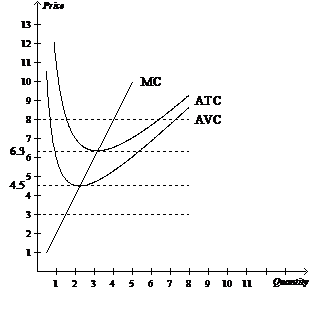
Effigy 14-1
Suppose that a house in a competitive market has the post-obit cost curves:
Refer to Effigy 14-1. The firm should shut downwards if the market price is
Question 11 (5 points)
Cold Duck Airlines flies between Tacoma and Portland. The company leases planes on a year-long contract at a cost that averages $600 per flight. Other costs (fuel, flying attendants, etc.) amount to $550 per flight. Currently, Cold Duck'due south revenues are $1,000 per flight. All prices and costs are expected to keep at their present levels. If it wants to maximize profit, Common cold Duck Airlines should
Question 12 (5 points)
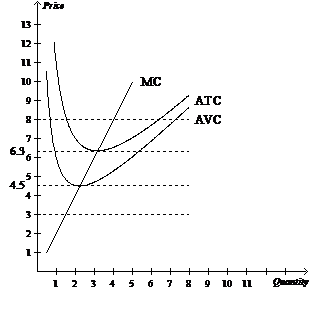
Figure fourteen-1
Suppose that a firm in a competitive market has the following price curves:
Refer to Effigy 14-one. The firm’s short-run supply bend is its marginal price bend in a higher place
Question 13 (five points)
If a competitive firm is currently producing a level of output at which marginal revenue exceeds marginal cost, and so
Question xiv (five points)
Table 14-thirteen
Diana’south Dress Emporium
| COSTS | REVENUES | |||||
| Quantity Produced | Full Cost | Marginal Cost | Quantity Demanded | Cost | Total Acquirement | Marginal Revenue |
| 0 | $100 | — | 0 | $120 | — | |
| 1 | $150 | one | $120 | |||
| 2 | $202 | 2 | $120 | |||
| three | $257 | 3 | $120 | |||
| four | $317 | 4 | $120 | |||
| 5 | $385 | 5 | $120 | |||
| 6 | $465 | half-dozen | $120 | |||
| vii | $562 | 7 | $120 | |||
| 8 | $682 | eight | $120 | |||
Refer to Tabular array fourteen-xiii. What is the marginal toll of the 1st unit?
Question 15 (5 points)
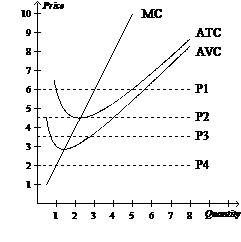
Figure 14-2
Suppose a firm operating in a competitive market place has the following cost curves:
Refer to Figure 14-2. Which of the four prices corresponds to a firm earning negative economic profits in the short run but trying to remain open?
Question sixteen (5 points)
Scenario 14-3
Suppose a certain competitive firm is producing Q=500 units of output. The marginal price of the 500th unit of measurement is $17, and the average total cost of producing 500 units is $12. The firm sells its output for $twenty.
Refer to Scenario xiv-3. At Q=499, the firm’s total costs equal
Question 17 (5 points)
When a restaurant stays open for lunch service even though few customers patronize the restaurant for lunch, which of the following principles is (are) best demonstrated?
(i) Fixed costs are sunk in the brusque run.
(2) In the curt run, only fixed costs are of import to the conclusion to stay open up for lunch.
(iii) If revenue exceeds variable cost, the eatery owner is making a smart determination to remain open for luncheon.
Question 18 (v points)
Suppose that a firm in a competitive market is currently maximizing its brusk-run profit at an output of l units. If the electric current cost is $9, the marginal cost of the 50th unit is $9, and the average total cost of producing 50 units is $4, what is the house'south profit?
Source: https://refinedpapers.com/profit-maximizing-firms-enter-a-competitive-market-when-existing-firms-in-that-market-have/
0 Response to "refer to figure 11-5. if the market price is $20, what is the amount of the firms profit?"
Post a Comment